
Imagine you are saving for an early retirement, you are maxing out your 401k, doing a backdoor Roth, and putting the rest of your money in a Vanguard investment account. You are doing great but unless you plan to die at 65 you should also think about maxing out your HSA account to pay for your retirement after you are 65. HSA is a wonderful tool and still one of the few vehicles that is accessible to everyone regardless of their income level. If you are into the FIRE movement (financial independence and retire early) you should absolutely have one.
So what is an HSA? HSA is a triple tax-sheltered account and if you live in the US and you are not maxing your HSA you are probably losing money. I see only one reason to not max out an HSA account and that is if you are saving for a big purchase like a house or a wedding or you have a huge unhealthy debt like a high interest credit card debt. Even if you have a mortgage you are probably better off saving for HSA assuming your interest rate for the mortgage is within healthy levels.
Triple tax sheltered means your deposits are tax free, your money grows tax free and your withdrawals are also tax free. I use HSA as part of my retirement planning and you should too.
A Health Savings Account (HSA) is a bank account, a combination of a savings account and trading account that are both tax deductible and work even better than your Roth IRA and your 401k. As we said, you invest in it tax free and withdraw from it tax free. I do use it to plan for my later days and you should too. An HSA won’t help you much when you are in your 30s or your 40s but after you are 65 you can withdraw from it without any penalty. Even before that, you can use it to pay for your medical expenses, your dental work, or whatever your insurance does not cover, I don’t touch my HSA money however and just leaving it there to grow. So imagine you expect to live until you are 90. My personal plan is to have enough money in my HSA to pay for the last 25 years for myself and my wife. With that reasoning whatever I can save in my HSA is justified and I do in fact max out my HSA every year ever since we bought our house (before that we were too focused to save for the down payment).
For an HSA you have to be enrolled in a high deductible healthcare plan. Which means you pay a smaller amount of money for your healthcare (big plus), your company will probably deposit some money into your HSA account too, say $1,500 (another big plus) and you can also deposit another $5,600 to your HSA to save for your retirement (the maximum you can add to your HSA is $7,100 for the year of 2020. This means the sum total of your contributions and your company’s contribution cannot exceed $7,100 in the year of 2020).
That said, if you are one of those people who get sick frequently and burn through your deductible every year then a high deductible plan is not probably useful for you but if you are healthy I recommend looking into switching to a high deductible health plan.
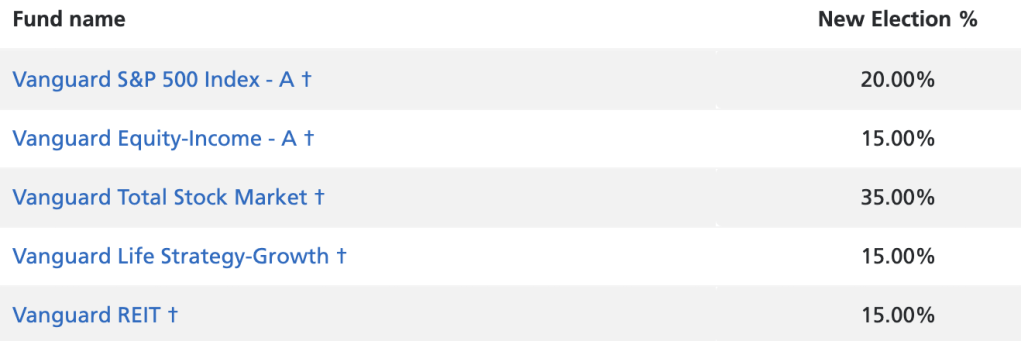
In your HSA account you can invest your money in various investment options. Below is the breakdown of my diversified investment. This is what I am comfortable with and you should set your own diversification plan. Plan to have a good mix of various investment options.
For more information, these series of videos can help you understand HSAs
Related links:
 Mark my money
One thought on “What is an HSA anyways”